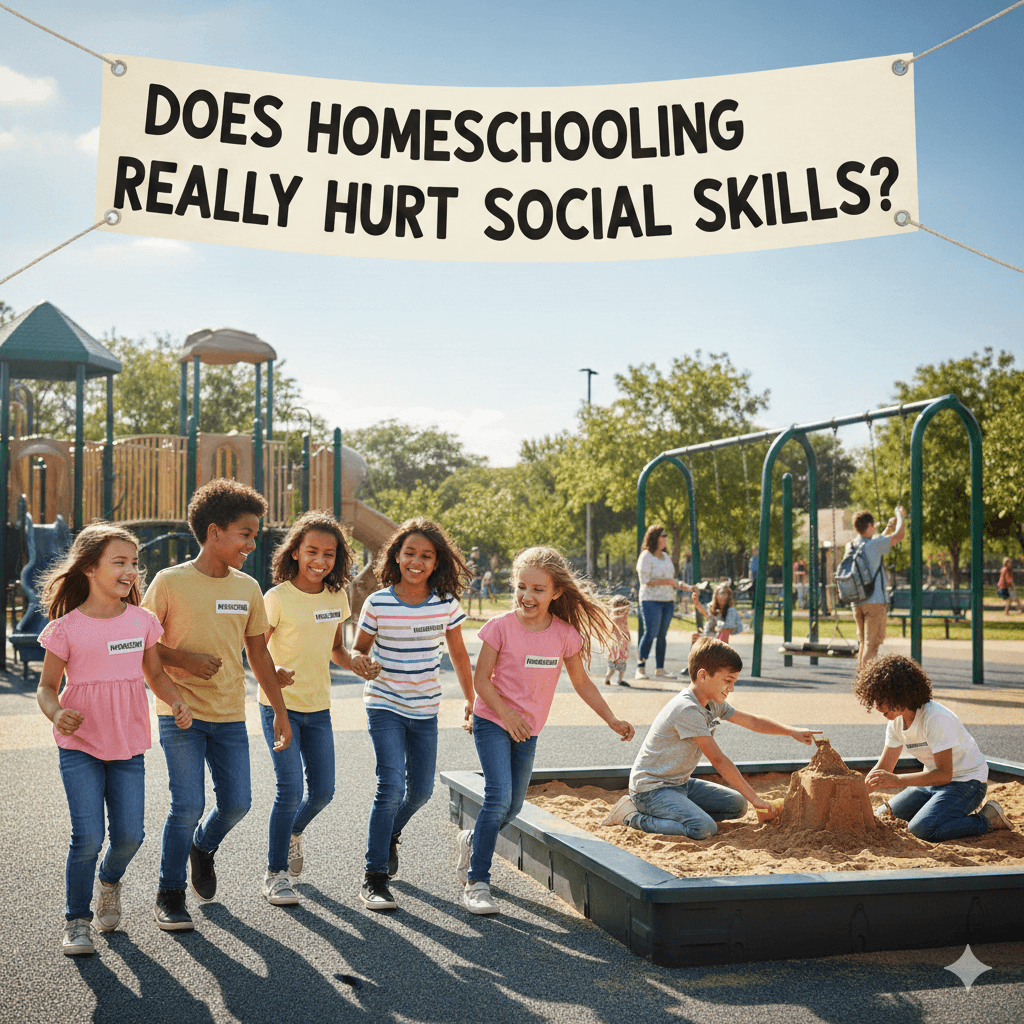
One of the first arguments people raise against homeschooling is almost always the same:
“But what about social skills?”
We’ve repeated this line so often that it’s nearly taken as fact. But when you look closely at the research, the story becomes far more nuanced.
Large reviews of the evidence (such as Medlin, 2013) have found no consistent evidence of social deficits among homeschooled children — a key finding in homeschooling social skills research. In fact, many studies report the opposite — homeschooled children often show strong self-concept, leadership, cooperation, and maturity in social settings.
A meta-analysis by Vaughn et al. (2015) even found that homeschooled children tended to have better peer relationships and were less likely to be bullied, addressing common concerns around homeschooling and bullying.
Key Research Findings on Homeschooling and Social Skills
1. Ray (2017) — A Nationwide Study of the Academic Achievement and Social Competence of Homeschooled Students
Key Finding:
Homeschooled students scored as well as or better than public- and private-school peers on measures of social competence — a core indicator of child social development.
Why It Matters:
This is one of the largest empirical studies comparing homeschooled and traditionally schooled children using standardized measures. It demonstrates that homeschooled children are not socially deficient; many perform at similar or higher levels on social adjustment scales.
2. Cogan (2010) — Exploring Academic and Social Development Outcomes of Homeschooling
Key Finding:
Homeschooled adolescents showed similar levels of social acceptance and leadership qualities compared with non-homeschooled adolescents, supporting positive adolescent social development.
Why It Matters:
This study used a large national dataset rather than small local samples, lending broader validity to the conclusion that social development in homeschooled youth is at least comparable to that of school-going peers.
3. Rudner (1999) — Scholastic Achievement and Demographic Traits of Homeschool Students in 1998
Key Findings:
Although focused primarily on academic achievement, this study also found that homeschooled children participated in extracurricular activities at rates equal to or higher than traditionally schooled children — a useful indicator of social engagement.
Why It Matters:
Social development is not limited to classroom peer interaction. It also includes participation in activities where children build relationships, teamwork, and confidence.
4. Assor & Tal (2012) — Directives and Autonomy Support in Homeschooling
Key Findings:
Autonomy support — giving children choice and agency in learning, a common feature of homeschooling environments — was associated with better social adjustment and psychological well-being.
Why It Matters:
This research shifts the focus from where learning happens to how it happens. It suggests that the quality of interaction and autonomy support plays a central role in social development.
5. Linebarger, Walker & Bartsch (2000) — Homeschool vs. School Peer Interaction
Key Finding:
Homeschooled children often had social networks that were more diverse in age and reflective of real-world social dynamics, including sustained interactions with adults and younger children.
Why It Matters:
This challenges the assumption that same-age grouping — a hallmark of traditional schooling — is essential for healthy social development.
6. Kokkinos & Kargiotidis (2018) — Bullying and Social Competence
Although this study focused on bullying in traditional schools, it is often cited in homeschooling research because it highlights how harmful certain school social environments can be for some children — something homeschooling can help mitigate when paired with strong social supports.
Rethinking the Question
So maybe the question isn’t:
“Will my child miss out on socialisation if they don’t sit in a classroom every day?”
Maybe the real question is:
What kind of social environment helps children feel safe, confident, and connected?
Because social skills development doesn’t occur simply by being around large numbers of same-age peers. They grow through:
secure relationships
meaningful conversations
mixed-age interactions
community involvement
being included rather than constantly compared
And yes — this can happen in schools. It can also happen outside them.
This doesn’t mean homeschooling is “better” for everyone. It isn’t. Many children thrive in schools with strong cultures, supportive teachers, and healthy peer networks.
But the idea that homeschooling automatically damages social skills?
That’s a myth the research doesn’t support.
A Simpler Takeaway
Children don’t need one specific system to grow socially. They need belonging, safety, and genuine connection — wherever that happens.
We’d love to hear your experiences. Whether you’ve homeschooled, considered it, or worked with homeschooled children — what have you noticed about social development?